.png)
DFX is one token for every verified USDT lost in the April incident. It is a standard SPL token on Solana, freely transferable and tradable on Raydium like any other SPL token. The total supply is 299,500,810.998 DFX, fixed at one DFX per verified USDT of loss, and no new DFX will ever be minted.
The Redemption Amount is the Recovery Pool Balance divided by Outstanding Supply. The Recovery Pool holds about 3.1M USDT today. It is funded once a day at 00:00 UTC, from Velocity’s Net Protocol Revenue and by any recovered funds. The Recovery Dashboard shows the Recovery Pool Balance, Outstanding Supply, and Redemption Amount in real time.
The pool will grow via:
- Net Protocol Revenue: Every day at 00:00 UTC, a share of Velocity’s Net Protocol Revenue flows directly into the Recovery Pool, denominated in USDT. This continues until the pool has received the full amount of verified losses.
- Tether Matched Deployment: Tether has committed up to 127.5M USDT to support relaunch and user recovery.
- Additional Partner Capital: Strategic partners have committed up to 20M USDT to support user recovery.
- Recovered Funds: Any stolen funds recovered through a freeze, the bounty, or law enforcement are directed into the Recovery Pool. Read the latest recovery update on X from Drift Foundation.
How to claim
If you had a verified loss, your allocation is already fixed in the loss snapshot.
Before you start:
- Use the wallet that controlled your Drift account on 1 April 2026. Any other wallet shows nothing to claim.
- Keep a small amount of SOL in that wallet for the network fee.
Steps:
- Go to the claim portal at https://dfx.drift.trade/
- Connect the wallet from which you lost funds. Your claim is tied to that address in the loss snapshot.
- Check your allocation. The portal checks your wallet against the loss snapshot with a Merkle proof and shows your exact allocation: 1 DFX per 1 USDT of verified loss.
- Agree to the DFX terms by ticking the boxes.
- Click Ready to Claim and approve the transaction in your wallet. If you have more than one allocation, approve each one.
- Wait for the "DFX claimed" message. The screen changes to “Already Claimed” with a View Transaction link, and the DFX is in that wallet.
Claim window: closes at 00:00 UTC on 1 January 2028. DFX that remains unclaimed when the window closes will be permanently burned.
If something looks wrong
- "No recovery tokens allocated": the connected wallet is incorrect. Switch to the wallet that held your Drift account.
- "Claim Failed": nothing left in your wallet. Try again.
Insurance Fund card: a separate claim with its own terms. It is not DFX.
Builders: If you built on Drift and want to prepare for the claim flow, see the CPI example
After you claim
You can:
- Redeem: burn DFX and receive USDT from the Recovery Pool at the Redemption Amount shown at the time of redemption.
- Sell: transfer DFX or trade it on secondary markets such as Raydium.
- Hold: keep your claim on the Recovery Pool as deposits arrive and supply falls.
How to redeem
- Open the DFX Redemption tab and connect any wallet holding DFX. It does not have to be the wallet you claimed with.
- Enter an amount, or use 50% or Max.
- Check the quoted Receive Amount and Redemption Amount.
- Confirm and approve in your wallet.
The DFX burn and the USDT payout happen in one transaction: both go through, or neither does. Redemptions are final. Amounts round down to the nearest 0.000001 USDT.
Recovery Tokenomics
Three properties define DFX: the Recovery Pool only grows, the Redemption Amount never falls, and supply only shrinks.
The Recovery Pool only grows. Every trade on Velocity feeds the Recovery Pool. Net trading fees split three ways: 15% goes to the Insurance Fund, 15% to vAMM capital, and the remaining 70% is Net Protocol Revenue. A share of that Net Protocol Revenue goes into the pool once a day, at 00:00 UTC, as outlined below. The share steps up as daily revenue grows, and each rate applies only to the revenue within its band:
Deposits stop once the pool has received the full amount of verified losses in total. Every deposit is an on-chain transaction and visible on the dashboard.
Redemption Amount
Redemption Amount = Recovery Pool Balance / Outstanding DFX Supply.
- Every revenue deposit raises the Redemption Amount. It steps up once a day, when the daily deposit lands at 00:00 UTC.
- A redemption leaves the Redemption Amount unchanged. It removes USDT and burns DFX in the same proportion.
- Anyone can redeem at the Redemption Amount from any wallet holding DFX, under the DFX terms.
Supply
There is no mint function. Supply is limited to 299,500,810.998 DFX. DFX can be burned in two ways:
- Redemption burns the DFX redeemed;
- Unclaimed DFX at the end of the claim window is burned.
After a burn, each future deposit is shared among the DFX remaining.
Effects of early redemptions
A holder who redeems at launch receives about 0.0104 USDT per DFX, and their DFX is burned. Future deposits into the pool are then shared among the remaining DFX holders.
For example, if 10% of the supply redeems, each remaining DFX receives about 11% more of every subsequent deposit. The same applies to any DFX left unclaimed and burned after the claiming window has passed.
Illustrative example:
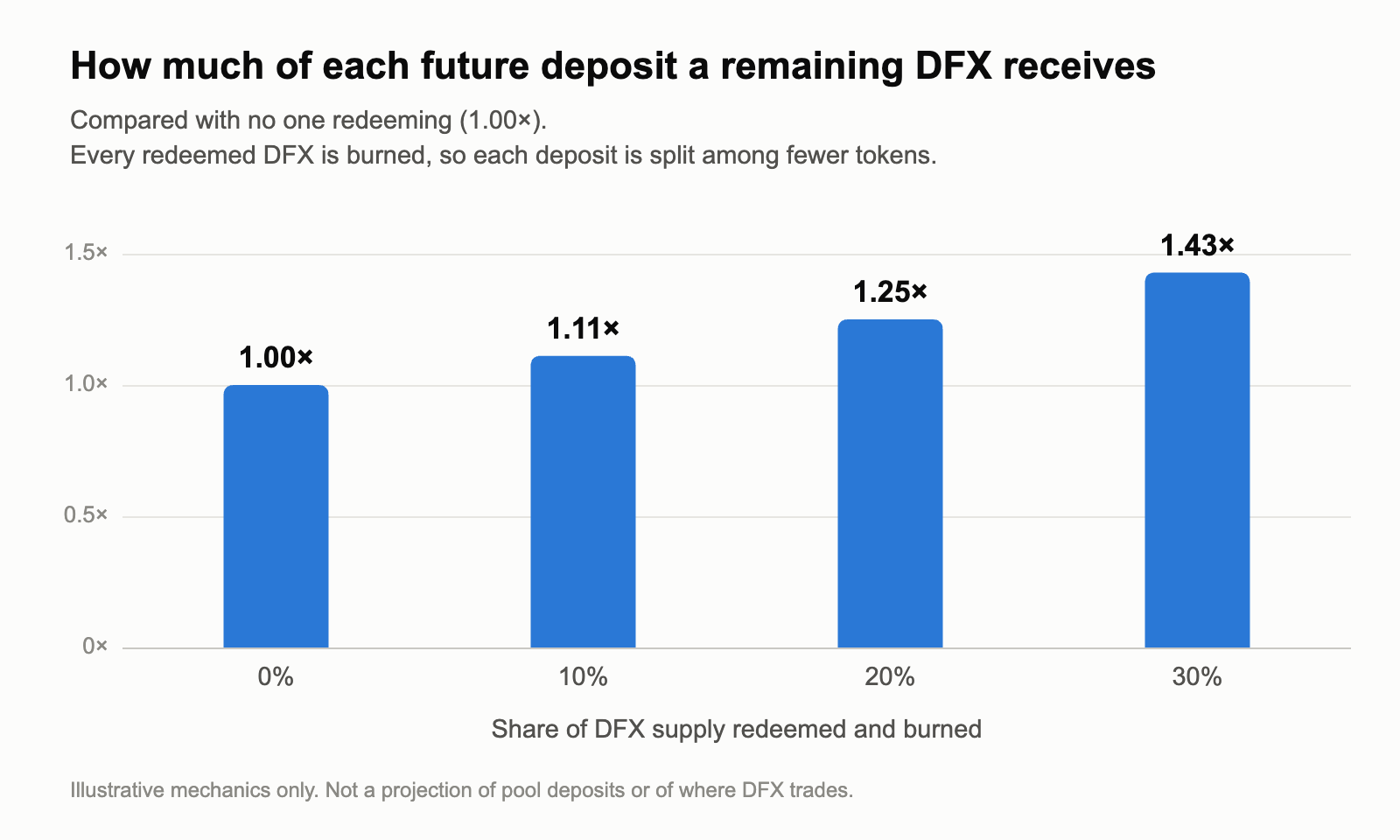
These figures illustrate the mechanics. They are not a projection or a promise. No representations are made as to where or how DFX will trade. That is for the market to decide. What the design provides is narrower: every holder can redeem at the Redemption Amount, the Redemption Amount does not go down, and the supply sharing future deposits only gets smaller.
This post is not financial advice.
.png)
.png)